An AI receptionist can handle family law intake, but only if it is configured for family law rather than borrowed from a personal injury script. The caller is usually upset, often making their first call to a lawyer, and sometimes in danger. The firm also has a problem no PI intake has to solve: the person on the line might be the opposing party in a matter you already represent. Good family law intake checks for conflicts before it hears a single fact, keeps a calm tone, books the consultation, and takes the consult fee on the call. This post walks through how that works and where an AI should stop.
What makes a family law call different
Most intake advice is written for injury firms, where the job is to qualify quickly and sign. Family law calls do not fit that mold.
The caller is emotional, and the emotion is the matter. A divorce or custody caller is describing their marriage, their children, and often the worst month of their life. A rushed or chirpy receptionist, human or AI, loses them in the first thirty seconds.
It is usually the first call. Many family law callers have never spoken to a lawyer. They do not know what a retainer is or whether calling means they have "started" a divorce. The intake has to explain the next step in plain words without giving legal advice.
Safety can be at stake. Some callers are in a parking lot because they cannot call from home. Some are asking about a protective order. The intake needs a short, firm-defined script that puts emergency services first.
The opposing party might call too. If your firm already represents one spouse and the other calls, anything your receptionist hears could create a conflict. A general-purpose script will not handle this.
Custody is urgent. A parent whose children were not returned, or who was served with an emergency motion, needs a consult today or tomorrow, and the intake has to book accordingly.
Fees are retainer-based. Family law firms charge consult fees and retainers up front. A caller who books but never pays is a no-show in waiting, so taking the consult fee during the call matters.
The opposing party problem
This is the part most answering services and AI receptionists get wrong.
Here is the failure. A caller says "I need a divorce lawyer," then spends four minutes on the finances, the affair, and the plan to move out. Only then does the receptionist ask for the spouse's name and find that the firm signed that spouse last Tuesday. The firm now has a potential conflict and has heard confidential information from the other side.
The fix is an order of operations: identify who is involved before hearing what happened. Reflekt's integrations with Clio, Filevine, Litify, MyCase, Lawmatics, and the other systems we support let the receptionist check against your existing matters during the call. If there is a potential conflict, the receptionist does not take the facts. It flags the call for attorney review and ends it politely. If there is not, the intake proceeds and the result is written to your CMS.
The AI is not making the conflict determination; the attorney decides. And the check is only as good as your CMS data. A firm that keeps new clients in a spreadsheet for a week before entering them has a gap no intake tool can close.
The same principle carries across the rest of a family law line. A custody emergency, a protective order inquiry, an existing client asking about Thursday's hearing, and a first-time divorce caller each need a different path, and the receptionist should know which one it is on before it goes further.
Tone: calm, specific, and no "great news"
Every vendor says its product is empathetic. In our after-hours audits of personal injury intake lines this year, the pattern testers scored worst on empathy was not coldness. It was scripted warmth: a receptionist, human or AI, that said something like "I'm so sorry to hear that, great news, we can definitely help!" and moved on without acknowledging what the caller had just said. It signaled nobody was listening. If scripted empathy fails for a car accident caller, it fails harder for someone describing the end of their marriage.
What works is simpler: slow down after the caller says something difficult, acknowledge what they actually said rather than reciting sympathy, say what happens next every time, and never take sides. That last one protects the firm if the caller turns out to be the opposing party.
We wrote more about why callers react to the shape of the experience rather than to who is talking in Do Clients Mind Talking to an AI at a Law Firm?. In our call data, 92% of clients never questioned whether they were talking to an AI and about 5% asked for a human.
Booking the consult and taking the fee
An intake that ends with "someone will call you back" has done half the job. The consult should be booked on the call, and if the firm charges a consult fee, collected on the call too.
Reflekt books consultations on the call and can handle payment and collection by phone, so the consult fee is collected before the call ends, and the firm decides whether payment is required to hold the slot, optional, or skipped for certain callers such as protective order inquiries.
Whether the AI or the attorney collects the retainer is a firm decision. Plan details are on the pricing page.
Existing clients and hearing updates
Family law matters run for months and involve a lot of dates, so a steady share of calls are existing clients. A client confirming a hearing time should not have to leave a voicemail and wait.
The receptionist shares only what the firm has approved for release, after confirming it is speaking with the client and not a family member or the other party, and routes everything else to the team. It does not interpret an order or predict a ruling. More in AI Case Updates for Law Firms.
What Reflekt will not do
Honest limits matter more in family law than almost anywhere else.
It will not give legal advice. The receptionist does not tell a caller whether they will get custody, whether they should move out, or whether a prenup will hold. Questions that call for a lawyer's judgment get a consistent answer: the attorney will cover that in the consultation.
It will not take sides. This is a courtesy to the caller and a safeguard for the firm.
It will not decide whether a conflict exists. It flags and routes. The attorney reviews.
It will not provide a human fallback. Reflekt does not offer human receptionists. During the hours your firm defines, the AI transfers live to your staff through call routing and live transfer. Outside those hours it completes the intake, books the consult, and flags anything urgent. If you want a person on standby for every call, a hybrid answering service is a better fit. The same goes if a partner takes every first call by policy, or if your CMS is not current enough to support a conflict check during the call.
It will not replace your safety protocol. Reflekt puts emergency services first and flags the call as urgent, but the firm writes the protective order script and decides the escalation path, including any referral to a local domestic violence agency.
Why after-hours matters for family law
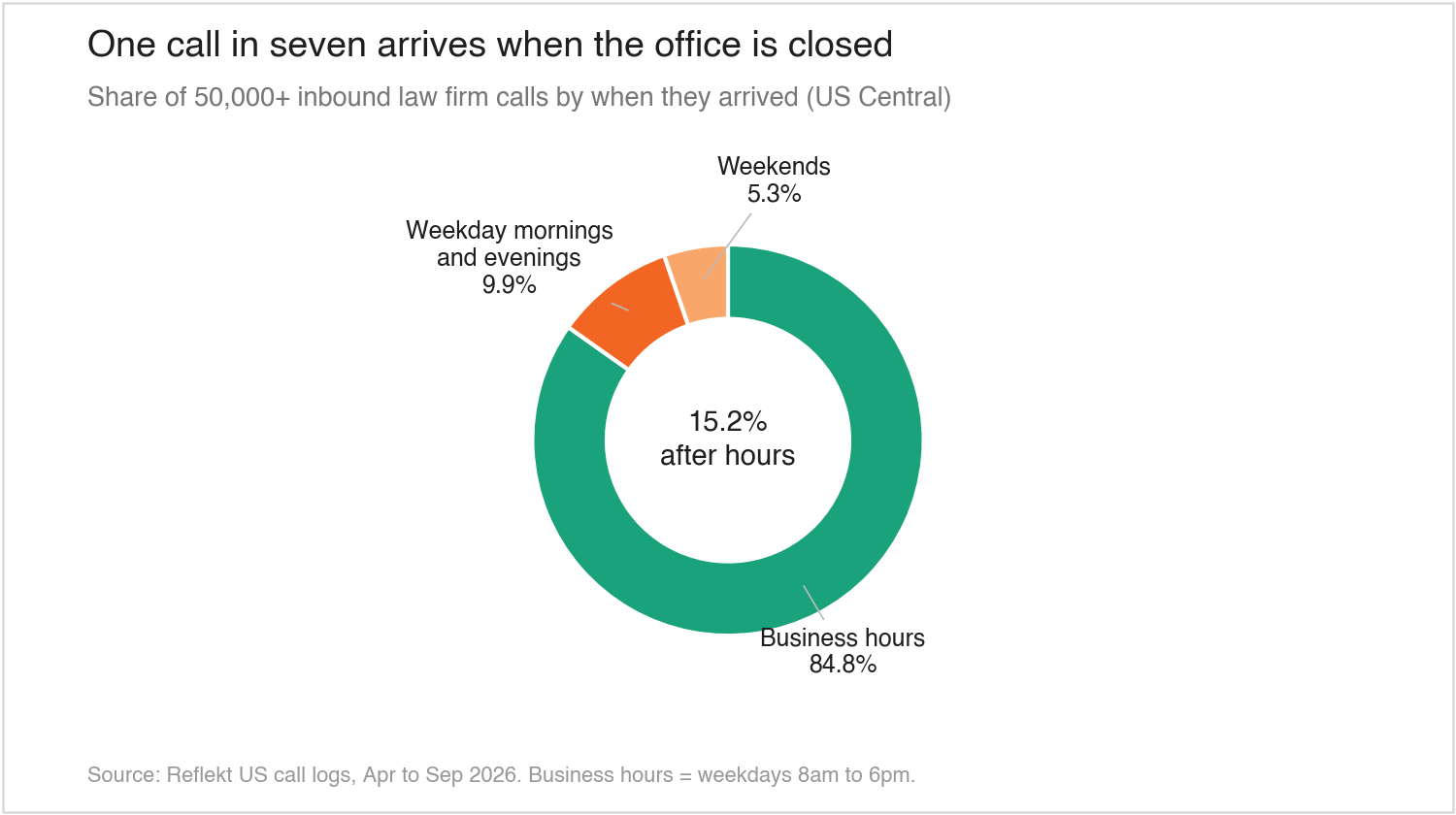
Family law callers often call after the kids are asleep, from the car, or on a weekend after an incident. Across the 50,000+ inbound calls Reflekt answered for US law firms between April and September 2026, 15.2% came in before 8am, after 6pm, or on a weekend. Weekends alone were 5.3%.
That figure covers every practice area we serve. After-hours calls are a minority, but they are often the ones where the caller is most distressed and least likely to try again.
Most intake failures are not AI failures. They are process failures: nobody answers, the message has no qualifying information, or the callback never comes. We laid that argument out in Why Legal Intake Systems Fail (It's Not the AI). For a family law firm, the process fix is specific: conflicts checked first, a calm tone, the consult booked and paid, and everything written to the CMS.
Frequently asked questions
Can an AI receptionist handle emotional family law callers?
Yes, if it is configured for family law rather than running a generic script. The receptionist needs to slow down, acknowledge what the caller actually said, and explain the next step every time. Scripted warmth ("great news, we can help!") is the pattern our intake audit testers flagged as a failure, and it fails harder in family law than in injury intake.
How does intake avoid a conflict with the opposing party?
By checking for a conflict against the firm's case management system before asking about any facts. If there is a potential match, the receptionist declines to discuss the situation, flags the call for attorney review, and ends the intake. The attorney, not the AI, makes the final conflict determination.
Can the AI collect a consultation fee?
Yes. The fee is collected before the call ends, and the firm decides whether payment is required to hold the slot. Retainers can be handled the same way or left to the attorney after the consult, which is what most family law firms we work with prefer.
What if a caller is in danger?
The intake directs them to 911 or local emergency services first, before anything else. The firm sets this script, including the wording, whether to refer to a local domestic violence agency, and how the matter is flagged for urgent follow-up.
Does the AI give legal advice?
No. It collects facts, explains the firm's process and fees, books the consultation, and writes a summary to your CMS. Questions that require a lawyer's judgment, such as whether the caller will get custody or whether they should move out, get a consistent answer that the attorney will cover those in the consultation.
If you want to hear how a family law intake sounds, you can interview your AI employee and call it with a custody emergency or an opposing-party scenario of your own. Plans start with a free tier, and the full details are on the pricing page.
