Mostly no, and the evidence points to a different problem. When Clio sent secret shoppers to call law firms in 2019, only 56% of calls were answered by a person and 39% went to voicemail. In a dataset of client calls answered by Reflekt's AI receptionist, 92% of clients never questioned whether they were talking to an AI, and only about 5% asked for a human. Prospective clients react to being unanswered, put on hold, or asked to repeat their story, not to whether the voice on the line is a person or an AI.
What the research actually measures
It is worth being precise about what we know and what we do not. There is no large public study that asked legal consumers "would you rather speak to an AI or a human at a law firm" and tracked what they did afterward. What we do have is a decade of research on how law firms handle inbound contact, and that research is unusually consistent about where callers get frustrated.
The best-known dataset is Clio's secret-shopper study from the 2019 Legal Trends Report. Clio's researchers called and emailed firms posing as prospective clients. A person picked up 56% of the time. Another 39% of calls went to voicemail, and more than half of the firms that received a voicemail did not return it within 72 hours. Email was worse: 60% of firms did not respond at all. On the consumer side, 82% of the people Clio surveyed said a quick response was important when choosing a lawyer, and 79% expected to hear back within 24 hours.
Six years later, Hennessey Digital ran a similar exercise focused on web forms. Its 2025 Lead Form Response Time Study submitted inquiries to 1,333 firms in the first quarter of 2025. The median response took 13 minutes, which sounds acceptable until you look at the distribution. Twenty-six percent of firms never responded at all. Only 25% got back within five minutes. Thirty-nine percent took more than two hours or never replied. When firms did respond, they picked up the phone 87% of the time and emailed 67% of the time, which tells you how much of the intake conversation still happens by voice.
Put those two studies together and the pattern is hard to miss. Roughly a quarter to a third of prospective clients who reach out to a law firm never get a response. Of those who do, a large share wait hours. None of that has anything to do with AI. It is what happens when a small firm's front desk is also its paralegal, its billing clerk, and the person running to court.
What callers actually react to
When we talk with firm owners who worry that an AI receptionist will put people off, the concern is usually framed as a preference question: will the caller feel brushed off by a machine? In practice, the reactions callers report are almost always about the shape of the experience, not the identity of the speaker. Below is how we would sort the complaints we hear, alongside the operational fix for each.
| What callers react to | Why it stings | What fixes it |
|---|---|---|
| Nobody answers, or the call rolls to voicemail | The caller is usually in a stressful moment (an arrest, an accident, a served notice) and a voicemail feels like a closed door. Clio found 39% of firm calls landed here. | Answer every call live, 24 hours a day, whether that is a person, an AI, or a person with AI backup. |
| Being put on hold with no idea for how long | Hold time is dead time. The caller starts dialing the next firm on the search results while they wait. | A receptionist that can take the full intake on the first call, so there is nothing to hold for. |
| Repeating their story to a second person | The receptionist takes a message, the paralegal calls back and asks the same questions, then the attorney asks again. Each retelling signals that nobody wrote it down. | Structured intake that captures the facts once and writes a summary to the case management system before anyone calls back. |
| A callback that comes hours or days later | Hennessey's median was 13 minutes, but 39% of firms took over two hours or never replied. By then the caller may have signed elsewhere. | Automated lead follow-up within seconds, plus scheduling on the first call so there is no callback to wait for. |
| Being asked questions that do not fit their matter | A generic script asks a defense-side adjuster about "your injuries," or asks a family-law caller about a police report. | Practice-area-specific scripts, so the questions match the matter. |
| Not being understood in their own language | A Spanish or Mandarin speaker gets an English-only line and hangs up, or a family member has to translate. | Language matching on the call, with an English summary delivered to the attorney. |
| Being dodged about who they are talking to | A caller who asks a direct question and gets a non-answer stops trusting everything that follows it. | A straight answer whenever the caller asks, and an immediate path to a human when they want one. |
Notice that AI appears in the right-hand column far more often than the left. Most of the things callers dislike are things an unstaffed or understaffed front desk produces by default, and things a well-configured AI receptionist removes.
Where an AI receptionist can still go wrong
None of this means callers are indifferent to how the AI behaves. There are three failure modes we take seriously, and they are the ones a firm should test before signing with any vendor.
The first is rigidity. An AI that cannot handle an interruption, a tangent, or a caller who answers three questions in one sentence will feel like a phone tree with better diction. Callers do not mind a robot; they mind a robot that makes them conform to it. The fix is a receptionist that follows a structured intake but can absorb information out of order and skip questions the caller has already answered.
The second is a missing exit. Some callers want a human, full stop. Sometimes it is a matter of temperament, and sometimes the matter is genuinely too sensitive or too tangled for a first-call intake. The AI needs to recognize that request, transfer live during business hours, and take a clear message with an escalation flag after hours. A firm should call its own line, say "I want to speak to a person," and see what happens. The third is the sensitive-matter problem. Criminal defense, family law, and immigration callers are often frightened and sometimes embarrassed. A receptionist that sounds chirpy, hurries them, or fails to acknowledge what they just said will lose them regardless of whether it is human or AI. The right tone is calm, unhurried, and specific to the practice area. Done well, it works: in our call data, distressed callers finished the intake 93% of the time.
What to say about who is answering
Firm owners usually raise this as a yes-or-no question: do we announce the AI at the top of the call? In practice, most of the firms we work with do not. The receptionist greets the caller the way any receptionist would, asks how it can help, and gets on with the intake. An announcement front-loads a conversation about the firm's software at the exact moment the caller wants to talk about their arrest, their accident, or the notice taped to their door.
What those firms do not do is deny it. If a caller asks whether they are speaking to a person, the answer is a plain no, given without hedging, and a transfer to a human is available if that is what they want. That line is the one that matters. A caller who asks a direct question and gets a direct answer has nothing to feel misled about. A caller who asks and gets a scripted deflection has every reason, and that is the version that costs a firm the relationship. "Do not announce, never deny" is the posture, and the second half is not optional.
This is still a judgment call your firm should make with its own rules in front of it, not a setting to inherit from a vendor. Disclosure requirements for automated systems are moving at the state level and some jurisdictions are more prescriptive than others, while bar rules on candor and on communications with the public govern how your firm presents itself generally. If your jurisdiction requires an announcement, or your matter types make one prudent, the receptionist can open with one. Confirm that with counsel.
What Reflekt's call data shows
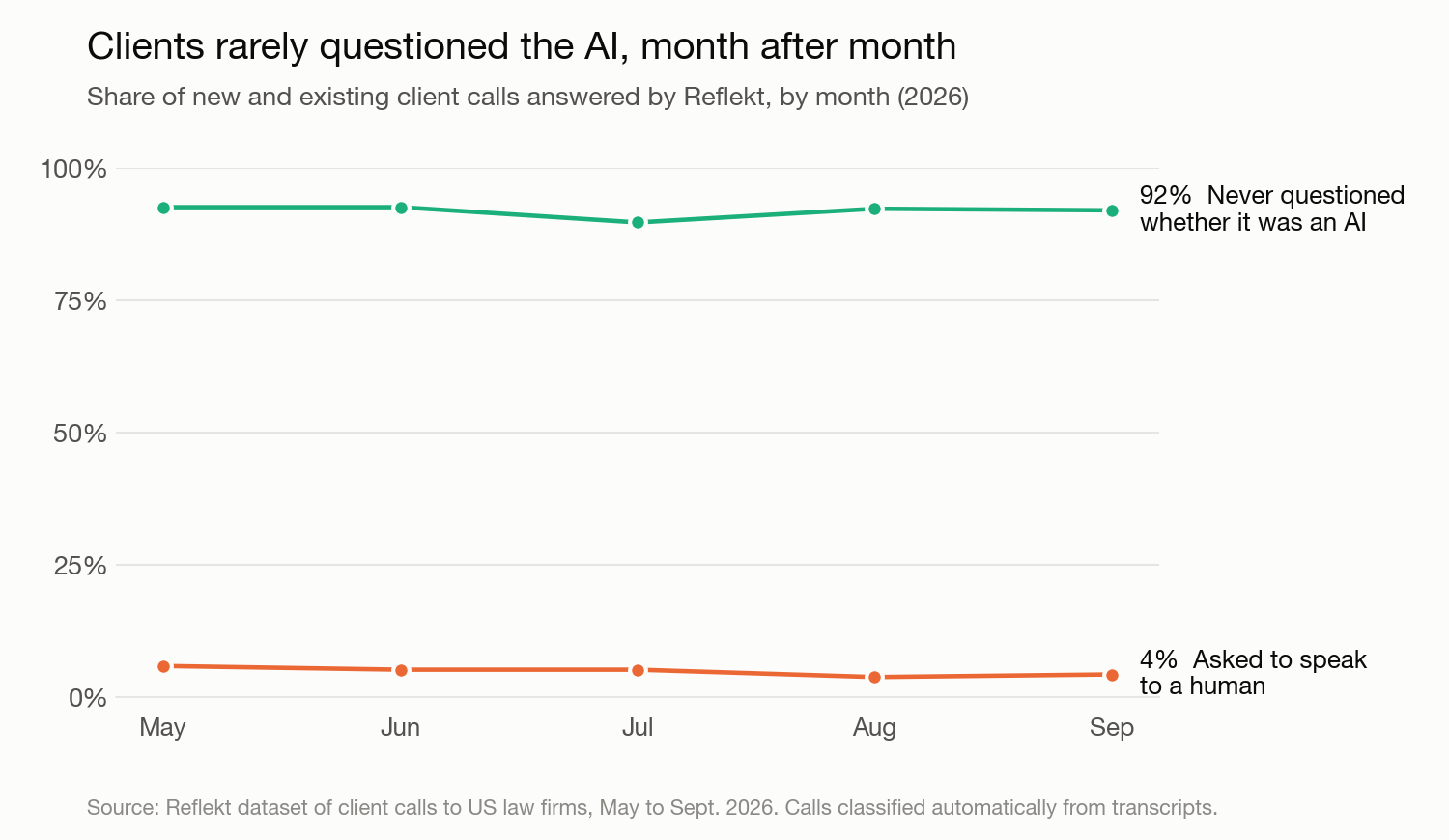
We analyzed a dataset of calls from new and existing clients that Reflekt answered for US law firms in 2026. Three numbers stand out:
- 92% of clients never questioned whether they were talking to an AI.
- About 5% asked to speak to a human.
- Only 1% of prospective clients refused to give their details.
Those numbers held steady month to month.
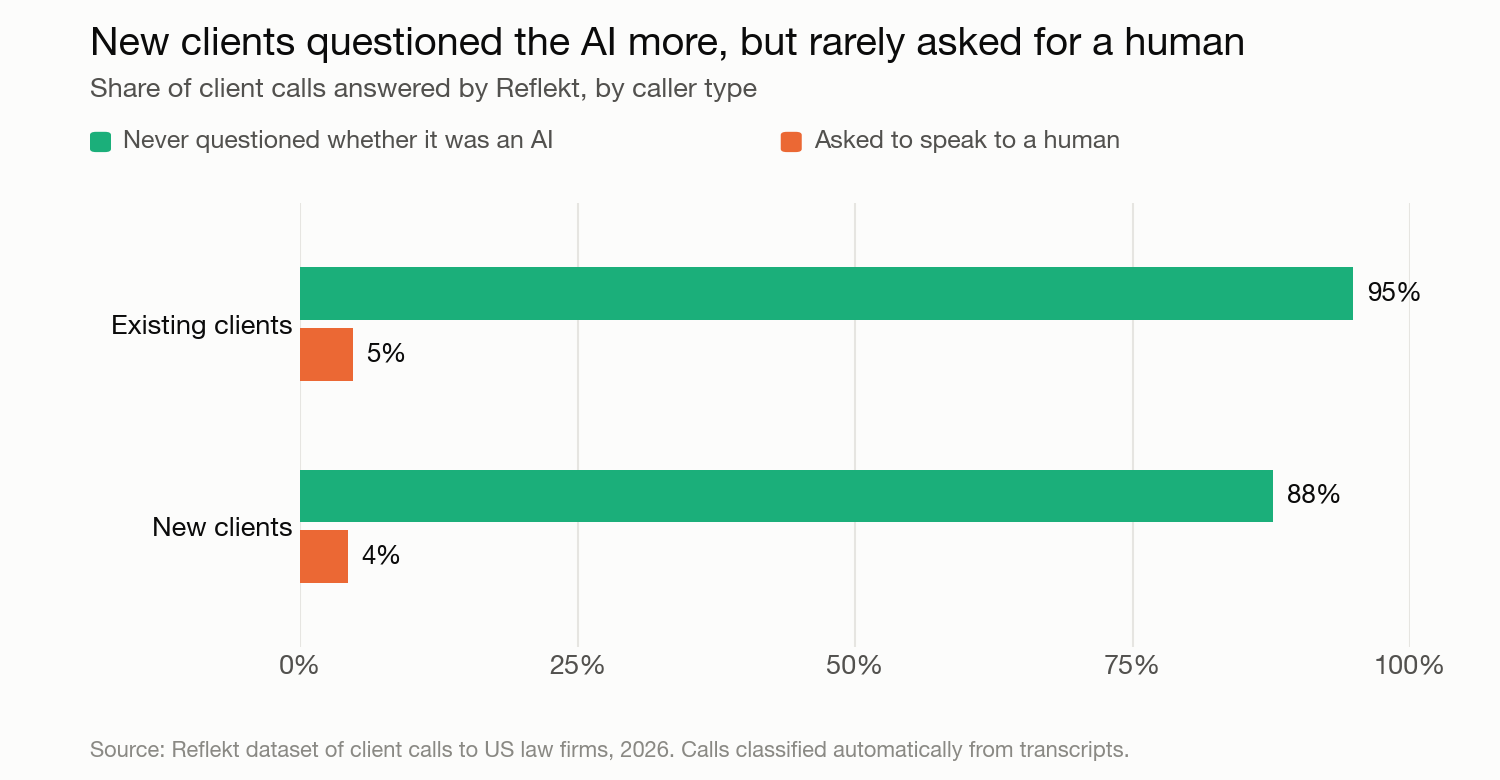
New clients were more likely than existing clients to ask whether they were talking to an AI, at 12% versus 5%. They were no more likely to ask for a person.
How to measure it at your own firm
Our numbers are a baseline, not a promise about your callers. If you want to settle the question for your own firm, three numbers matter, and you can collect all of them from call recordings and your case management system within a month.
The first is completion rate: what share of callers who reach the AI actually finish the intake, as opposed to hanging up partway through. The second is the request-a-human rate: how often callers ask to be transferred, and at what point in the call. A high rate early in the call points to a tone problem, or simply to callers who want a person. A high rate late in the call usually means the intake script is asking for something the caller is not ready to give. The third is show rate: whether people who book a consultation through the AI actually appear, compared with people booked by your staff. If the show rate holds, callers were not put off.
We would encourage any firm to run this comparison against its current setup. If you currently send after-hours calls to voicemail, the honest comparison is between the AI and a voicemail box, not between the AI and an idealized human receptionist who does not exist at 11 p.m. on a Saturday.
How Reflekt handles this
Reflekt's AI Legal Receptionist is built around the fixes in the table above rather than around sounding human. It answers every call live, 24 hours a day, and runs a structured intake specific to the caller's practice area, whether that is personal injury, criminal defense, or one of the defense-side areas like insurance defense, where the "caller" is often an adjuster rather than an injured person. The facts are captured once and written as a summary to your case management system through the call summaries and CRM sync feature, so nobody at the firm has to ask the caller to repeat themselves.
When a caller asks for a person, the receptionist transfers live during hours you define using call routing and live transfer. Outside those hours it takes the intake, schedules a consultation, and flags the matter for a callback. Callers are matched to their language automatically across 15 or more spoken languages, and the attorney receives the summary in English.
Two honest limits. First, Reflekt does not offer human receptionists as a fallback; if you want a person on standby for every call, a hybrid service is a better fit, and we say so in our comparison pages. Second, the figures above come from our own customer base, which is weighted toward immigration, personal injury, and employment matters, and we cannot yet publish show-rate figures. The right approach is to run the free tier against your own calls and measure your own.
Frequently asked questions
Do clients hang up when they hear an AI answer the phone?
In our experience the hang-ups that matter happen before anyone answers, when a call rings out or hits voicemail. Clio's secret shoppers found 39% of law firm calls went to voicemail. Once a call is answered, most callers stay on the line: in Reflekt's call data, only about 5% of clients asked to be transferred to a human. Callers mostly care that they are understood, that their story is written down, and that they get a time to talk to an attorney.
Should a law firm announce that callers are talking to an AI?
Most of the firms we work with do not announce it at the start of the call; the receptionist greets the caller and begins the intake. None of them deny it. If a caller asks whether they are speaking to a person, the answer is a plain no, and a transfer to a human is available on request. Disclosure rules for automated systems vary by state and are changing, so confirm your own obligations with counsel.
Can a caller reach a human if they ask?
They should be able to. Any AI receptionist a firm considers should recognize a request for a person, transfer live during defined hours, and take a flagged message after hours. Test this yourself by calling your own line and asking for a human at different points in the call, including mid-sentence.
Will an AI receptionist frustrate callers in sensitive matters like criminal defense or family law?
It can if it is rushed, generic, or overly upbeat. The fix is practice-area-specific scripts and a calm, unhurried tone. Frightened callers respond well to being asked relevant questions in a steady voice and being told exactly what happens next. That applies to humans and AI alike.
How do I know if callers actually mind talking to my AI?
Measure three things over a month: the share of callers who finish the intake, the share who ask for a human and when, and the show rate for consultations booked through the AI compared with those booked by staff. Compare against what you have now, which for many firms is voicemail after hours.
Does an AI receptionist work for callers who do not speak English?
Some do. Reflekt matches callers to their spoken language automatically and covers 15 or more languages, with an English summary sent to the attorney. Other vendors offer bilingual coverage or add multilingual only on enterprise plans, so ask specifically which languages are handled on the call itself, not just in a follow-up text.
If you want to hear how it sounds for yourself, you can interview your AI employee and call it with your own toughest intake scenario. Plans start with a free tier, and the full details are on the pricing page.