
An AI receptionist can work for a criminal defense firm, but only if it is set up for how defense calls actually arrive. The caller is often a parent or spouse, not the person charged. The call comes at 2 a.m. from a jail line that needs a keypress before it will connect. The caller wants to explain everything, and the one thing a good intake must do is stop them. A generic answering script built for car accidents will get all of this wrong. A receptionist built for defense work treats every call as urgent, collects names and contact information before facts, and gets the matter in front of a lawyer as fast as the firm allows.
Why criminal defense intake is different
Most intake advice assumes the caller is the client. In criminal defense, that is often not true. The person in custody cannot call around to compare firms. Their mother, their partner, or a friend does it for them, usually within hours of the arrest, with incomplete information, and frightened. They may not know the exact charge or which facility the person is in, only that they need a lawyer before the first court appearance.
That creates four problems a defense receptionist has to handle that a personal injury receptionist does not.
The first is urgency with a deadline attached. Bond hearings and arraignments happen on the court's clock, not the firm's. A family calling on Friday night may need an attorney at a hearing on Monday morning. An intake that takes a message for a Tuesday callback has already lost the case.
The second is the jail line itself. Calls from correctional facilities are placed through systems that announce the call, then wait for the receiving party to press a key to accept it. Many automated phone systems cannot do that. They answer, hear the prompt, and the call drops. From the caller's side, the firm did not pick up.
The third is conflict screening. A defense firm cannot take details about a case until it knows it is not already representing a co-defendant, a victim, or a witness. A receptionist that lets a caller describe the whole incident before anyone checks for a conflict can create a problem the firm did not have before the phone rang. The names have to come first.
The fourth is the recorded line. Jail and prison calls are recorded and monitored, and prosecutors can obtain those recordings. The worst thing an intake can do is prompt a person in custody to explain what happened. A defense receptionist has to collect contact and logistical information only and tell the caller, clearly, not to discuss the facts.
How Reflekt handles jail and prison calls
Calls from correctional facilities don't connect like ordinary calls. The facility's system announces the call and waits for the receiving end to press a key before it lets the caller through. We solved this in our first months working with defense firms, and it has been standard for every firm on the platform ever since: when a facility system asks for a keypress, Reflekt's receptionist sends it, the call connects, and the conversation proceeds like any other inbound call. We wrote up how it works in How Law Firms Use AI to Accept Jail and Prison Calls Reliably.
Once connected, the receptionist identifies the caller, checks the firm's case management system to see whether they are an existing client, and either logs a message to the matter or transfers to the attorney if the firm has live transfer on for that hour. It also says, in plain words, that the line is recorded and the caller should not describe what happened. That instruction is written into the defense script, not left to chance.
What to collect, and what not to collect
A good defense intake does two things at once. It gathers enough for the firm to act quickly: who is calling, who is in custody and where, the charge and the next court date, and the names the firm needs for a conflict check. And it keeps the caller from telling the story of what happened, which belongs in a privileged conversation with the attorney, not on an intake line.
The skill is doing the second without making a frightened caller feel cut off. A good receptionist acknowledges what the caller is saying, explains that the attorney will want to hear it directly, and moves on to getting the consultation booked. Reflekt's criminal defense intake is built around that balance, and the summary it writes to the firm's CMS or CRM records the logistics and the booked consultation, not a narrative.
When defense calls come in
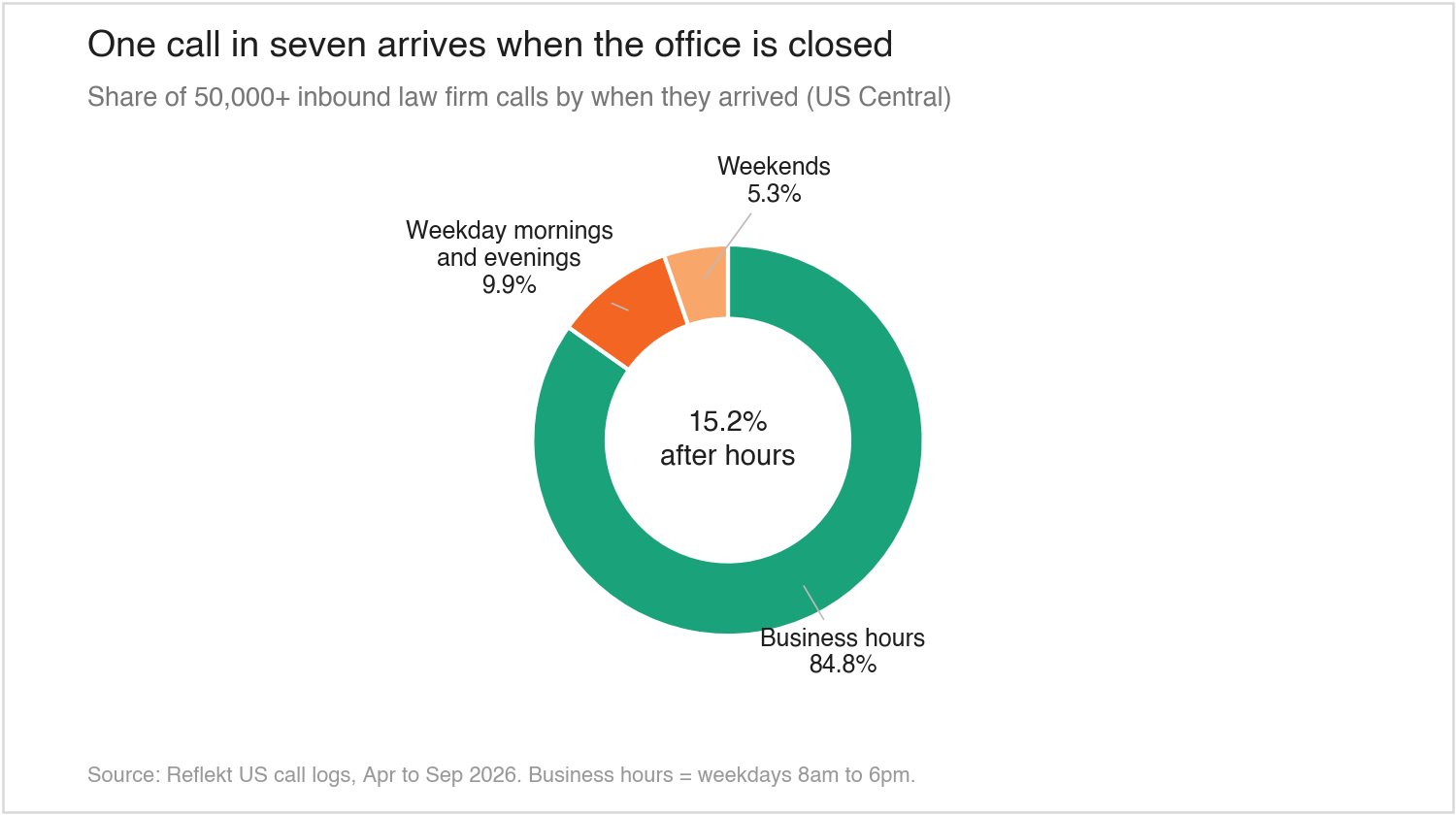
We looked at the 50,000+ inbound calls Reflekt answered for US law firms between April and September 2026. Of those, 15.2% came in after hours, meaning before 8 a.m., after 6 p.m., or on a weekend, in US Central time. Weekend calls alone were 5.3%. The busiest hours were 10 a.m. through 3 p.m., each carrying 11% or 12% of calls, and the hours between 8 p.m. and 6 a.m. together carried about 3%.
Those firms are weighted toward personal injury and immigration, where callers tend to phone during the workday. Arrests are not scheduled around business hours. A criminal defense firm should expect a larger share of its calls at night and on weekends than the 15% in our data, and the calls that arrive then are the most time-sensitive ones the firm receives all week.
If after-hours calls roll to voicemail today, the honest comparison is not between an AI receptionist and a seasoned intake specialist. It is between an AI receptionist and a voicemail box at 1 a.m. on Saturday, when the family is calling down a list of firms until someone picks up. The firm that answers and books Monday morning is usually the firm that gets hired.
Existing clients and court dates
A defense firm's phone line is not only for new matters. Many calls are from existing clients, or their families, asking a question the firm has already answered: when is the next court date, which courtroom, has the hearing moved. Each one interrupts a paralegal, and each one is unanswerable by an answering service that cannot see the file.
When the receptionist can read the matter, it recognizes the caller, confirms the matter, and reads back the court date and location on record. It logs the call so the attorney can see the client called. During the firm's transfer hours, the client can reach the assigned attorney or paralegal directly. We describe the pattern in AI Case Updates for Law Firms.
Reflekt connects to Clio, Filevine, Litify, MyCase, Lawmatics, Law Ruler, Lead Docket, Lawcus, BackDocket, Neos, and SmartAdvocate, reading matter data for routing and writing intake records, notes, and tasks. If your firm keeps court dates somewhere the receptionist cannot read, it will take a message rather than guess.
Will frightened callers talk to an AI?
The question comes up with every defense firm we speak to, and it is fair. Someone whose son was arrested two hours ago is not in a mood to be handled by software. What we have seen is that callers in a crisis react to whether they are answered, understood, and given a next step, far more than to who or what is answering. In the client calls Reflekt has handled, 92% of clients never questioned whether they were talking to an AI, and about 5% asked for a human. We wrote about that in Do Clients Mind Talking to an AI at a Law Firm?.
Tone is where this is won or lost. A defense intake has to be calm, unhurried, and specific, and it should never sound upbeat. When the caller asks for a person, the receptionist should say plainly that it is an AI and, during hours the firm defines, transfer to one. Outside those hours it should take the intake, book the consultation, and flag the matter for the first person in the door.
Frequently asked questions
Can an AI receptionist take calls from jail?
Only if it can respond to the facility system's prompt to accept the call. Jail and prison lines wait for the receiving party to press a key, and many automated systems cannot do it, so the call drops. Reflekt sends the required dial tone, connects the call, and then runs a limited intake that collects identifiers and tells the caller not to discuss the facts on a recorded line.
Should a criminal defense intake collect case facts?
No. The intake should gather what the firm needs to act, such as who is calling, who is in custody, the charge and the court date, and the names for a conflict check. It should not take an account of what happened, and on a jail or prison line it should actively tell the caller not to give one. The attorney hears the facts in a privileged setting, not on an intake call.
What does a defense firm need from an after-hours answering service?
It needs the call answered live, not sent to voicemail, because arrest calls arrive at night and on weekends and the family is calling other firms if nobody picks up. It needs the intake to collect identifiers and court timing, flag the matter as urgent, and book a consultation before the first hearing. It also needs to handle jail calls and to reach an attorney if the firm allows after-hours transfer.
Can the AI run a conflict check?
It can collect the names the check requires, including the defendant, co-defendants, the alleged victim, and witnesses the caller knows of, and write them to the firm's case management system before any case details are discussed. The firm then runs the conflict check against its own records. The AI should not claim to clear conflicts itself.
Will callers in crisis talk to an AI?
In our experience, yes, as long as the receptionist is calm, acknowledges what they say, and gives them a clear next step. In Reflekt's client call data, 92% of clients never questioned whether they were talking to an AI and about 5% asked for a human. Callers in a crisis react to being unanswered or rushed far more than to who is on the line.
If you run a defense firm and want to hear how this sounds, interview your AI employee and call it as a parent whose son was just arrested, then call it again from a jail-style prompt. Plans start with a free tier, and the full details are on the pricing page.
