
11 posts tagged with "LawFirms"

View All Tags

· 4 min read

People do not dislike AI at law firms. They dislike bad systems.

There is a persistent belief in legal intake that callers will reject AI the moment they realize they are not speaking to a person. In practice, that is rarely what drives frustration. Most callers are not evaluating your staffing model or forming an opinion about your technology stack. They are trying to answer a much simpler question: am I being heard, and is this actually moving forward?

When the experience answers that question clearly and confidently, people are generally comfortable. When it does not, frustration follows, regardless of whether the interaction is handled by a person, a script, or a machine. The emotional response is tied less to the presence of AI and more to whether the process feels effective and responsive.

The comparison that breaks decision making

Many firms approach this decision as a comparison between human intake and AI intake, but that framing is often misleading. Human reception and intake teams tend to be evaluated at their best: attentive, fully trained, fully staffed, never rushed, and consistently available at the right moment. AI, on the other hand, is typically judged at its worst: generic, rigid, incapable of nuance, and disconnected from real workflows.

This uneven comparison makes rational decision making difficult because neither side is being evaluated under real operating conditions. A more useful lens is system versus system. What actually happens on a Tuesday at 11:20 a.m. when the phones are ringing, the team is stretched, and a caller reaches out in a high stress moment? That is the environment that determines outcomes, not idealized scenarios on either side.

What callers actually care about

Inbound legal calls are not seeking perfection as much as they are seeking clarity. Callers want to explain their situation once, feel confident that it was understood, and leave the interaction with a next step they can trust. When those elements are present, the experience feels professional and reassuring.

Where intake starts to fail

Breakdowns tend to occur when the process introduces friction, such as long hold times, repeated questions, loss of context between handoffs, or unclear follow up. Even a friendly human interaction can feel ineffective if those issues persist. Conversely, when a system listens carefully, captures context accurately, routes information intelligently, and closes the loop quickly, callers tend to experience that as helpful and competent, regardless of whether AI was involved in the process.

The challenge is that most of these breakdowns are not obvious from the inside. From the firm's perspective, the process can feel functional, even when it is creating friction for callers.

The part most firms cannot see

A significant challenge for many firms is the lack of clear visibility into their current intake performance. Key questions often go unanswered: how many calls are missed, how quickly callbacks occur, which types of calls consume the most time, and where potential clients drop out of the process. It is also common to lack insight into whether callers are repeating themselves across multiple touchpoints or how often conversations end without a clear next action.

Without this level of visibility, it becomes easy to assume the current process is mostly effective and to evaluate new systems against an idealized version of existing operations. In reality, improvement requires a grounded understanding of actual performance. Both AI driven and human workflows need to be assessed against measurable outcomes rather than assumptions.

What we are really building

At Reflekt Legal, the focus is not on replacing care with automation, but on building stronger systems for legal teams. That means designing workflows that capture intent accurately, preserve context throughout the interaction, and make follow through measurable. It also means giving firms operational visibility into call volume, call types, response quality, and ultimate outcomes.

Well designed systems reduce the likelihood of missed opportunities while allowing attorneys and staff to concentrate on the work that truly requires their expertise. The objective is not to mimic human conversation for its own sake, but to ensure that every caller feels heard and understands that their issue is being handled with urgency and clarity.

When that standard is met, the presence of AI becomes largely irrelevant to the caller. What matters is that the firm responded effectively and moved the situation forward.

· 4 min read

The update calls that quietly shape the day

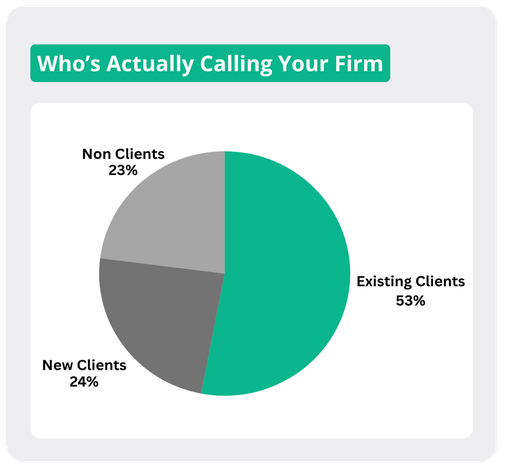
When people think about inbound calls at law firms, the focus usually lands on new leads. But many firms also handle a steady stream of calls from existing clients who just want to know where things stand. From what we have seen across firms, on average more than half of monthly inbound calls fall into this category. Not all of them are routine, but it gives a clear sense of the scale.

Who is actually calling your firm: pie chart of existing clients, new clients, and non-clients

These are not complicated conversations. They are quick check-ins, often driven by a need for reassurance or clarity, yet they tend to land right in the middle of everything else your team is trying to do.

In a typical flow, a receptionist answers, gathers details, and then tries to connect the caller with someone who has matter context. If that person is in a meeting, in court, or already on another call, the client waits or the team adds another callback to the list. Nothing about this is fundamentally broken, but it quietly pulls your team away from the work that actually moves cases forward.

Over time, that tradeoff becomes harder to ignore. Time spent tracking down updates is time not spent preparing filings, thinking through strategy, or helping a client through something that actually requires legal expertise. The cost is that it can slow down the very progress the client is calling to ask about in the first place.

As we worked through these workflows with firms, the question was not just whether AI could answer status questions. It was whether it could give your team that time back in a meaningful way.

That is what led to Case Updates. The goal is straightforward: let the AI handle routine status calls from start to finish so your team does not have to step away from meaningful work to relay information that already exists in your systems. Instead of pausing a call while someone searches for records, the AI verifies the caller, pulls the right context from the CRM or CMS, and answers the question immediately.

This is not about reducing touch points with a client. Instead, it is about recognizing that your team creates the most value when they are helping clients make progress and not when they are repeating information that is already available.

How it works in practice

When an existing client calls, the AI confirms identity using the firm's process and available records. Once it matches the caller to the correct matter, it retrieves the latest case context in real time.

If the request is a routine update, the AI handles it on the spot, removing the need for holds, transfers, or interruptions to your team's workflow. Instead of pulling someone out of their current task to check a system and relay information, the update is delivered immediately and accurately within the same conversation.

The result is fewer context switches and fewer small interruptions that break up deep, focused work. And when something does require human input, the call still routes to the right person, but now it comes with context so your team can focus on solving the problem rather than reconstructing it.

What this unlocks for firms

Clients still get answers quickly, but your team is no longer the bottleneck for routine information. They remain engaged in the work that actually requires judgment, experience, and sustained attention.

That shift changes the rhythm of the day. There are fewer interruptions, less time spent on repetitive tasks, and more time available for the kind of work that moves cases forward. It also changes how clients experience your firm. They continue to feel informed, but when they do speak with your team, the conversation centers on progress, decisions, and next steps rather than basic status updates.

Case Updates is not about removing conversations. It is about ensuring your team is fully present for the ones that matter most.

Handle routine case updates without interrupting legal work

See Case Updates and your AI client communication workflow in a live walkthrough.

See it in Action

· 4 min read

How to scale law firm intake without missed calls or lost leads

Every growing firm eventually hits the same uncomfortable tradeoff. On one side is the way many attorneys want to practice: answering calls personally, listening long enough to understand the situation, and carrying context from conversation to conversation so clients feel known rather than processed. On the other side is volume. More marketing, more referrals, and more matters mean more inbound demand, and there are only so many hours in a day.

No one can be in two places at once. A lawyer in court cannot pick up the phone. A lawyer deep in drafting cannot always break away for a fifth scheduling call. And yet the person on the other end of the line is often calling at a moment that already feels urgent to them. The tension is not philosophical. It is operational. It shows up as voicemail, callbacks that slip, and leads that cool off while the firm is doing good work elsewhere.

Scaling a law firm is not only a question of hiring more attorneys. It is a question of how the firm captures, qualifies, and routes demand before it ever becomes a retained matter. If intake does not grow with visibility and reputation, growth creates frustration on both sides. The firm feels like it is leaving opportunity on the table, and callers feel like they are being asked to wait during the exact window when they most want a response.

Some teams respond by pushing intake to whoever is available. That can work for a while, but it often pulls paralegals and assistants into repetitive triage instead of higher leverage work, and it still breaks down when volume spikes. Other firms hire dedicated intake staff, which can be the right answer at scale, but it introduces training, coverage, and consistency challenges of its own.

What firms are really trying to preserve is not that every single conversation must be with a partner. It is that the experience still feels attentive, coherent, and respectful of the moment the client is in. Personability is not the same thing as every call being answered by the same person. It is that the firm does not go quiet when someone reaches out.

What law firm missed calls and slow follow-up actually cost

The worst outcome in this equation is not that a firm chooses to delegate or systematize parts of intake. The worst outcome is silence. A missed call at the wrong time is not a minor administrative slip. For the caller, it can land as abandonment at a stressful point in their life. For the firm, it is a case that never starts, a relationship that never forms, and a reminder that demand and attention are permanently out of sync.

That is the problem we think about at Reflekt Legal. We are not trying to replace judgment, advocacy, or the conversations that define a lawyer’s relationship with a client. We build AI employees that handle administrative load and routine dialogue: the structured questions, the follow-ups, the scheduling threads, and the continuity that keeps matters from stalling because nobody had time to send the next message.

The goal is to widen the firm’s intake capability without asking attorneys to shrink their ambition for how clients should be treated. When predictable work is handled consistently in the background, lawyers and staff are freed to spend their limited time on the exchanges that actually require expertise, empathy, and strategic thinking.

Keeping a personal client experience as the firm grows

Scaling a personal client experience sounds like a contradiction until you separate the parts of client communication that benefit from a lawyer’s presence from the parts that mostly need reliability, speed, and a clear next step. Clients still deserve a human when the situation calls for it. They also deserve a firm that answers, remembers what was said, and does not lose the thread between channels.

That is how we think about building systems for legal teams: expand what the firm can respond to, reduce what falls through the cracks, and protect attorney time for the work only a lawyer should do. Growth does not have to mean choosing between being personal and being available. It has to mean being both, on purpose.

Keep the conversation going

Learn more about what we are doing at Reflekt Legal.

Meet with us

· 4 min read

Reflekt Legal started with a simple realization about how much of our time was being pulled away from the work we were actually good at. It came from a frustration we experienced firsthand as founders. We found ourselves spending a disproportionate amount of time on repetitive follow-up calls and conversation tracking, when our goal was to be solving problems and building for the people we serve.

After spending time in the legal world, we learned that this tension was not unique to us. Across conversations with attorneys and legal teams, the same pattern continued to surface. They were not looking for another piece of software to manage. They were looking for a way to reduce attention to administrative work that surrounds legal practice. They wanted less time managing the constant flow of intake, follow-ups, and routine updates and more time advising clients, applying judgment, and advocating effectively: helping them.

What we heard from firms at SXSW

That message became especially clear at our event hosted during SXSW week. Across conversations during the event, one theme kept resurfacing: lawyers want to build relationships; lawyers want to help their clients. They want to apply judgment, advocate effectively, and solve clients' problems. The gap between what attorneys are trained to do and what their day often demands remains wider than it should be, and it is often defined by the operational responsibilities required to keep a practice moving, from capturing new matters to maintaining ongoing client communication and ensuring nothing falls out of sync.

In practice, this shows up in ways that are both familiar and consequential. Follow-ups do not always happen because attention is elsewhere, missed calls turn into missed cases, and leads that come in through ads or webforms often sit without a timely response. Scheduling stretches into back-and-forth exchanges, conversations require manual tracking across channels, and routine client updates or internal handoffs depend on coordination that is easy to delay. Each of these moments is small in isolation, but together they shape how a firm grows, how consistently it operates, and how clients experience the firm over time.

What we are building and why

This is exactly where our product focus comes from. We are not trying to automate the practice of law or replace legal reasoning. We are focused on building systems that remove avoidable friction around legal teams, so attorneys can remain focused building relationships with and helping their clients. In practice, that has led us to build AI intake employees designed to handle conversations across calls, webforms, emails, and inbound leads in a way that is structured, consistent, and aligned with how firms already operate, while also supporting the broader communication layer that extends beyond initial intake.

That system exists to make sure conversations do not stall or get lost. It maintains continuity, carries context forward, and reduces the need for constant manual coordination. Instead of adding another tool to manage, it becomes part of the operational layer that quietly supports how firms engage with both prospective and existing clients.

Central to this approach is the belief that much of the work surrounding legal practice is conversational and process-driven, even when it sits outside of pure legal reasoning. Building an AI system that can manage those conversations with the nuance and continuity of a human allows us to support legal teams without pulling them further into operational overhead. It allows us to take responsibility for the surrounding processes that keep a firm running, while attorneys stay focused on the legal work itself.

Our mission

"Let Lawyers Be Lawyers" is the clearest way we can describe that direction. It reflects the reason we started building in the first place, the feedback we continue to hear from firms, and the standard we hold ourselves to as we expand the platform. We have experienced what it feels like when operational work pulls problem-solvers away from the areas where they are most effective, and we have seen how consistent systems can reshape how that work gets done. Our focus is to continue building in a way that narrows that gap, so that the time and attention of legal teams are aligned with the work that defines their value, while the processes around them are handled with the same level of consistency and care.

· 5 min read

We brought together around 100 lawyers, operators, founders, and investors in Austin during SXSW for a focused conversation on AI in legal. It was a discussion about how artificial intelligence is actually being implemented inside law firms today. The goal was simple: share practical insights and perspectives from different parts of the legal tech community about how legal AI is already changing how law firms operate.

Austin is quickly emerging as a hub for legal tech, and this event was designed to contribute to that momentum. By bringing together practitioners, operators, builders, and investors, the conversation reflected multiple perspectives on the same shift. The most valuable insights came from where those perspectives overlapped and, at times, disagreed. That tension is where real progress tends to happen in emerging markets like legal AI.

Scaling Law Firms Without Losing the Human Element

The first panel focused on a core operational challenge facing modern law firms: how to scale without losing the personal client experience that defines legal work. Unlike many industries, legal services are often delivered during high stress, high stakes moments. Clients expect and should receive direct access to their lawyer during these urgent and emotionally charged times in their lives.

At the same time, the reality inside most firms is constrained by time. Lawyers are in court, managing caseloads, and balancing competing priorities. Missed calls and delayed responses are common, and they often occur at the worst possible moments for clients.

This is where AI for law firms is beginning to show measurable value. Rather than replacing lawyers, the most effective implementations focus on handling repetitive, routine workflows across the firm. This includes tasks like client intake, document drafting, case status updates, legal research, billing, scheduling, and internal coordination. By automating these workflows, firms can improve their responsiveness and create consistency across cases without sacrificing the quality of human interaction. The outcome is more time for lawyers to focus on building stronger client relationships.

The second panel shifted toward the legal tech market itself, with founders and investors discussing what is actually working. The conversation moved quickly beyond experimentation and into adoption patterns across firms.

A clear trend emerged: law firms are moving away from isolated point tools and toward end to end workflow solutions. Instead of stitching together multiple products that each solve a narrow problem, firms are prioritizing platforms that can manage entire processes from intake through resolution.

This shift has important implications for companies building legal tech. Owning a full workflow increases both value and defensibility. It also raises a broader strategic question: when a platform becomes deeply embedded in how a firm operates, does it remain a vendor, or does it begin to function as infrastructure?

That question is still evolving, but it is already shaping how the next generation of legal AI companies are designed and positioned in the market.

Panel two photo

Several themes were consistent across both panels and conversations throughout the event. AI adoption in legal is no longer theoretical; it is actively being deployed at the workflow level. The firms seeing the strongest results are using AI to support human interaction rather than replace it. At the same time, the market is consolidating toward platforms that own meaningful portions of the client journey, rather than tools that operate in isolation.

There is also increasing alignment between lawyers, operators, founders, and investors on where the industry is heading. The conversation is shifting from whether AI should be used, to how it should be implemented effectively.

This event marked an important step in our broader effort to help establish Austin as a leading legal tech hub. The city has a strong combination of talent, capital, and a growing base of operators. Our approach is to continue creating environments where these groups can come together, exchange ideas, and push the conversation forward. Events like this are one part of that effort, but the longer term goal is to support sustained communication across the ecosystem.

What Comes Next

We are continuing to work with law firms that are moving from experimentation with AI tools to full implementation of automated workflows. For firms evaluating how AI fits into their operations, the focus is no longer on isolated tools but on building systems that improve responsiveness, efficiency, and client experience at scale.

If you are exploring how to implement AI in your law firm, or evaluating legal workflow automation, we are actively working with teams navigating that transition. More events and conversations are coming soon.

Keep the conversation going

Learn more about what we are doing at Reflekt Legal.

Meet with us

Thank You

Thank you to everyone who joined us and contributed to a thoughtful, practical discussion on the future of legal AI.

Thanks to our sponsors: Slingshot Law, Deep Invent, Aparti, FVF Law, Preminger Law, Quake Capital, ClaimExchange, Fractal Group, Robotax, Backdocket

· 5 min read

Strong network, fragile process

One firm walked us through their referral partners and it was honestly impressive. They had trusted firms for family law, immigration, criminal defense, employment, and a handful of niche areas that only come up when you have been in the community for a long time. It was the kind of network you build over years: relationships you can rely on, people you know will take care of someone you cannot.

Then we asked a simple question: once you decide it is not a fit, how does the referral actually happen? The answer was always some version of "we send an intro," but when we watched the workflow, that intro depended on a person remembering the next step, picking the right partner, drafting the email, and hitting send in the middle of a busy day. The network was solid, but the handoff was fragile, which meant referrals could be delayed, inconsistent, or missed entirely even when the firm's intentions were good.

Why referrals matter, and why the handoff breaks down

When someone reaches out to a law firm, they are rarely doing it casually. They are trying to solve a problem and they want direction quickly, even if the answer is "we are not the right firm for this." A thoughtful referral can turn that moment into a positive experience, because instead of a dead end the person gets a clear next step and a warm connection to someone who can actually help. And for firms, referrals are not just a nice gesture either: they strengthen partner relationships, reinforce a reputation for being responsive, and in many cases represent a real revenue stream.

The issue is that most firms already have the hardest part solved, which is knowing exactly who they trust, but the handoff itself still relies on manual execution after the conversation ends. Writing a good intro takes a little focus, so it lands in someone's inbox, gets pushed to later when the phone keeps ringing, and becomes inconsistent depending on who took the call and how hectic the day is. In the meantime, the inquirer is waiting and the partner firm never gets looped in while the person is still engaged, which is the exact gap we wanted to eliminate with Smart Referrals.

Once we saw this pattern across firms, it clicked for us that referrals were the perfect job for an AI employee. If the AI employee is already having the conversation, already determining that the matter is not a fit, and already collecting the right basics, then the referral should be a continuation of the interaction.

That is why we built Smart Referrals. The goal is simple: when a call or conversation ends with "we cannot take this, but we know who can," the AI employee should be able to initiate the referral immediately, using the firm's existing referral list and the same kind of introduction a great staff member would send.

How it works in practice

Smart Referrals triggers right after the intake interaction ends. If the matter is outside the firm's practice area or otherwise not a fit, the AI routes the referral to the right partner based on the firm's preferences, whether that is practice area, jurisdiction, case type, or any other routing rules the firm uses.

From there, the AI handles the introduction. It drafts and sends the referral message to the partner firm and includes the inquirer or shares the necessary contact details so both sides can connect without friction. The message includes basic context from the conversation so the partner firm understands what the person needs and can pick up the thread without forcing the inquirer to repeat themselves from scratch.

Learn more

What this unlocks for firms

Smart Referrals turns referrals into something firms can rely on operationally. Partner relationships get reinforced through consistent, professional intros, and the firm captures more value from inquiries that would otherwise end as a polite decline. Over time, that can make referrals feel less like an occasional favor and more like a dependable system.

It also improves the inquirer experience in a way that is easy to underestimate. Being referred out can feel like rejection when it is slow or vague, but it feels like help when it is immediate and specific. Instead of waiting for a manual follow up, the person gets routed to the right firm while they are still motivated to act, which makes the handoff smoother for everyone.

At the end of the day, the referral network has always been there. Smart Referrals is about making the handoff as strong as the relationships behind it, so firms can help more people, support partner firms, and turn "not our case" into an outcome that still creates value.

Turn warm referrals into immediate, consistent handoffs

See Smart Referrals and your AI intake workflow in a live walkthrough.

See it in Action

· 4 min read

The calls nobody was counting

One of the surprises we ran into while working with growing law firms was how much of their phone traffic had nothing to do with new leads. A firm would tell us they were getting slammed, and everyone assumed that meant more intake calls. Then we looked closer and found a huge share of calls coming from insurance adjusters, medical providers, and treatment offices calling in with updates, requests, and quick questions tied to existing cases.

What really stood out was that the firm did not fully realize how many of these calls they were getting, or how much time they were spending just trying to figure out who the caller was, which case they were talking about, and where the call should go. By the time someone located the right client, found the claim details, and transferred the caller, the quick update had already turned into a huge time sink.

When this traffic is mixed in with everything else, teams tend to treat it as background noise. But once you quantify it, you start seeing patterns: how much vendor and adjuster traffic the firm gets, which cases generate the most inbound activity, and where bottlenecks show up inside the firm. That insight is hard to get when callers are bounced around and notes live in someone’s head.

Once we saw how common this was, our solution, Smart Routing, felt like an obvious fit for AI employees. Caller identification, intent detection, case lookup, and routing are all things that can happen in the background while a conversation is still unfolding. And if the AI can surface the right case context instantly, it can either route the call to the right person immediately or, in many situations, resolve the update without needing to interrupt anyone at all.

That is what Smart Routing is designed to do. It dynamically routes and handles calls in real time, not just based on a static phone tree, but based on who is calling, what they are calling about, and what the firm’s rules say should happen next.

How it works in practice

Smart Routing listens for intent signals and identifies the caller type, whether that is an existing client, a vendor, a medical provider, a new lead, or an insurance adjuster. Mid conversation, it can search the firm’s CRM or CMS in seconds, pull up the relevant client record, and surface key details like case or claim identifiers, recent contact history, and any notes that matter for the handoff.

From there, Smart Routing can take two paths. If the right outcome is a transfer, it routes the call to the correct person or department immediately. The person receiving the call also gets a short whisper message with context, so they know who is calling, which client it relates to, and what the caller is trying to accomplish before they even say hello.

If the right outcome is to capture an update, the AI can handle that directly. For example, if a provider is calling to share a treatment update or confirm something simple, the AI can record the details and log them into the CMS under the correct client record. That means the information lands where it should, tied to the right case, without someone having to pause their work to track it down.

Learn more

What this unlocks for firms

The most immediate benefit is speed and accuracy. Calls get to the right person faster, and when they do, the recipient has context instead of starting cold. That makes the firm easier to work with for adjusters and providers, and it reduces the internal back and forth that happens when callers are transferred multiple times.

The second benefit is clarity. Once Smart Routing is in place, firms start seeing what their inbound traffic actually looks like: how many adjuster calls are coming in, how many provider updates, what kinds of requests are most common, and where the team is spending time just moving information around. That visibility helps firms tighten processes, set expectations, and decide what should be handled by a person versus what can be captured automatically.

At the end of the day, Smart Routing is about removing friction from the calls that keep cases moving. It keeps routine updates from derailing your staff, it gets callers to the right place faster, and it turns please hold while I find that into a workflow that happens automatically in the background.

Route vendor and adjuster calls with the right case context

See Smart Routing and your CRM working together in a demo.

See it in Action

· 4 min read

The notification maze inside most firms

One of the firms we worked with had a very organized system for internal updates. Every department had its own email address: billing, existing clients, new inquiries, case management, and a few others that had evolved over time. When something important happened on a case, the right people were supposed to be looped in through one of these channels so everyone who needed to be updated was.

The system worked, but only when someone remembered to use it. A case status would change, and someone on the team would need to think through who should know, which inbox to include, and whether the update belonged in email, Teams, Slack, or somewhere else. None of this was complicated, but it relied heavily on memory and habit.

Every firm has its own way of doing this

What made this interesting is that every firm handled these updates a little differently. Some preferred email threads. Others relied on Slack channels or Teams notifications. A few used text messages for urgent updates. And almost every firm had its own unwritten rules about when certain people should be notified and when something could wait.

We quickly realized this was not a problem firms wanted to standardize. These processes evolved over years, and teams were comfortable with them. Asking firms to change how their internal communication worked would create more friction than it solved.

Instead of asking firms to adapt to a new process, we decided our AI employees should adapt to theirs.

That is where Smart Updates came from. Firms can tell the AI employee how they want to be notified, when certain events should trigger an update, and which channel should be used. It might be an email to a department inbox, a Slack message in a case channel, a Teams notification to a group, or even a text message for something time sensitive.

Once those rules are in place, the AI handles the rest. When the status of a case changes or a relevant event happens, the AI sends the update to the right people through the channel the firm already uses.

How it works in practice

Smart Updates listens for the same case events your team already cares about: status changes, new information coming in, documents received, or actions completed by the AI during an intake or follow up conversation.

When one of those events happens, the AI checks the firm’s notification rules and sends the update automatically. The right people get notified through the right channel, without anyone having to remember who to message or where to post the update.

The information also stays tied to the client matter in the CRM or CMS, so the update is not just floating in chat history or buried in someone’s inbox.

What this unlocks for firms

The biggest benefit is consistency. Updates happen every time they are supposed to, not just when someone remembers. Teams stay aligned without relying on manual reminders, and the firm’s existing communication habits stay intact.

It also highlights something we care a lot about when building these systems: flexibility. Law firms already have processes that work for them. Smart Updates shows how AI employees can fit into those processes rather than forcing teams to rebuild how they operate.

At the end of the day, the goal is simple. The right people should know what is happening on a case without anyone needing to think about how to notify them. Smart Updates makes that automatic while respecting the way each firm already works.

Send case updates to Slack, Teams, or email automatically

See Smart Updates fit your firm’s existing notification habits.

See it in Action

· 2 min read

The call most systems cannot handle

While building call workflows for law firms, we ran into a situation that most automated phone systems simply do not support. Some calls were coming from state or city prisons and jails. These calls use systems that require the person receiving the call to press a dial tone or key to accept the connection.

For many automated reception systems, that requirement breaks the call entirely. The system answers, but it cannot respond to the dial tone prompt, so the call never actually connects. From the caller's perspective, it just looks like the firm cannot accept the call.

Building Dial Tone Support

Once we understood the issue, the solution was straightforward: our AI employee needed to behave like a real call recipient when the system requested a dial tone confirmation.

Now when one of these calls comes in, the AI can automatically send the required dial tone input and accept the call. From there, the conversation continues normally and the caller can reach the firm just like any other inbound call.

Why we made it standard

This is not a flashy feature, but it is an important one. Calls from correctional facilities are part of everyday legal work for many firms, and they should not break simply because an automated phone system is involved.

Once we solved the problem, we decided to include it as a baseline capability for all of our clients. It is a small detail, but it is the kind of real world edge case that good infrastructure should handle without anyone having to think about it.

Accept jail and prison calls automatically

See how AI intake handles correctional call flows end to end.

See it in Action

· 5 min read

The follow-up problem that quietly costs firms cases

As we built AI intake employees and spent more time watching how intake actually happens inside firms, we kept noticing the same pattern. A lead would call, the conversation would go well, everyone would agree on the next step, and then things would slow down. Not because the firm did not know what to do, but because the next step lived in someone's head, a sticky note, or a Slack message that was easy to lose track of once the day got busy.

It is not hard to see why this happens. Intake moves quickly, the phone keeps ringing, and teams are juggling a lot at once. But the result is familiar: leads stall, documents do not get requested on time, a follow up call slips by a day or two, and suddenly the case feels colder than it should. Most firms are good at deciding the next step. The challenge is making sure the next step actually happens.

Why the manual approach breaks down

In most firms, task creation tends to happen at the worst time: right after a call ends, when the phone is already ringing again. A staff member either creates the task immediately, which is hard to do consistently, or they plan to do it later, which often means it competes with everything else and gets delayed. Even teams that are very disciplined run into the same constraints. When intake volume spikes, the first thing to suffer is the administrative glue that keeps cases moving.

We also saw how easy it is for tasks to be created in the wrong place, attached to the wrong client, or assigned to someone who is not the right owner. Over time, that turns tasks into noise, and once tasks feel noisy, people stop trusting them.

A number of firms asked us directly for a better way to keep follow ups from falling through the cracks, and the request was clear: can your AI employee create the next steps inside our CRM, tied to the client matter, so we do not have to?

That fit perfectly with how we think about AI employees. If the AI is already reviewing each lead conversation, collecting the key facts, and understanding what the firm needs to do next, then task creation should not be a separate manual step. It should be automatic, structured, and attached to the case where the team already works.

How it works in practice

After a lead call or intake conversation, the AI generates case specific tasks based on what happened in that interaction and what the firm's workflow expects next. That might be scheduling a consult, requesting missing documents, sending a retainer, confirming insurance information, following up on an unanswered question, or any other repeatable step the team uses to move matters forward.

Those tasks are created directly in your CRM and attached to the right client matter, so they are not floating in a separate tool or living in someone's notes. Just as importantly, the AI assigns tasks to the right person based on role, availability, and case context, which keeps ownership clear and prevents the common problem of tasks being created but not truly owned.

Once tasks are in place, the case has a defined next step that can be tracked, surfaced, and completed. The team does not have to wonder what is supposed to happen next, and the system does not rely on someone remembering to translate a good call into follow through.

What this unlocks for firms

The immediate benefit is momentum. Leads stop stalling because every prospective client gets a clear next step that is assigned and tracked automatically. That reduces the quiet drop off that happens between great conversation and we should follow up, and it helps firms move cases through the early funnel with more consistency.

The second benefit is operational clarity. When tasks are created and assigned consistently, firms get a more accurate picture of workload and throughput, including which steps are slowing matters down and where handoffs are breaking. Over time, that makes it easier to tighten the process and keep the team focused on the work that actually requires human judgment.

At the end of the day, Case Tasks are about making follow through a built in part of intake instead of an extra step that depends on bandwidth. The AI employee captures what needs to happen next, routes it to the right person, and logs it where the firm already manages the matter, so cases keep moving without the team having to carry every reminder in their heads.

Create CRM tasks from intake so nothing drops after the call

See Case Tasks and intake automation in a demo.

See it in Action