An AI receptionist works for an immigration law firm when it does three things on the first call: answers in whichever language the caller is already speaking, recognizes the difference between a detention emergency and a routine case-status check, and hands the attorney a clean English summary. Language is the whole game. In Reflekt's own secret-shopper tests of law firm phone lines, Spanish-speaking callers reached a human 47% of the time, against 63% for English callers, and 39% of Spanish calls reached nobody at all.
Why language decides the call
Immigration callers do not arrive in English by default. Depending on the firm's city and the communities it serves, the first language on the line is often Spanish, and after that Portuguese, Mandarin, Haitian Creole, Vietnamese, Arabic, or something else entirely. The person on the phone frequently is not the client. It is a sister, a spouse, an adult child, or a pastor calling on behalf of someone who cannot call for themselves, either because they are detained or because they do not trust their own English on a phone with a lawyer's office.
That changes what "answering the phone" means. A bilingual receptionist who works 9 to 5 solves the problem for the hours she is at her desk and for the one other language she speaks. Everything outside that window, and every third language, falls to voicemail or to whichever paralegal picks up.
Reflekt's receptionist detects the language the caller speaks and answers in it. It covers 15 or more spoken languages, switches without a menu prompt, and runs the same structured intake it would run in English. The summary that lands in the case management system is written in English, with the caller's preferred language noted so the firm knows how to call back.
What the audit data says about Spanish callers
Between May and September 2026, our team made 79 after-hours test calls to 45 firms that primarily practice personal injury, 43 in English and 36 in Spanish. We are publishing the full findings in a separate post on after-hours intake audit results, but the language split is worth pulling out on its own.
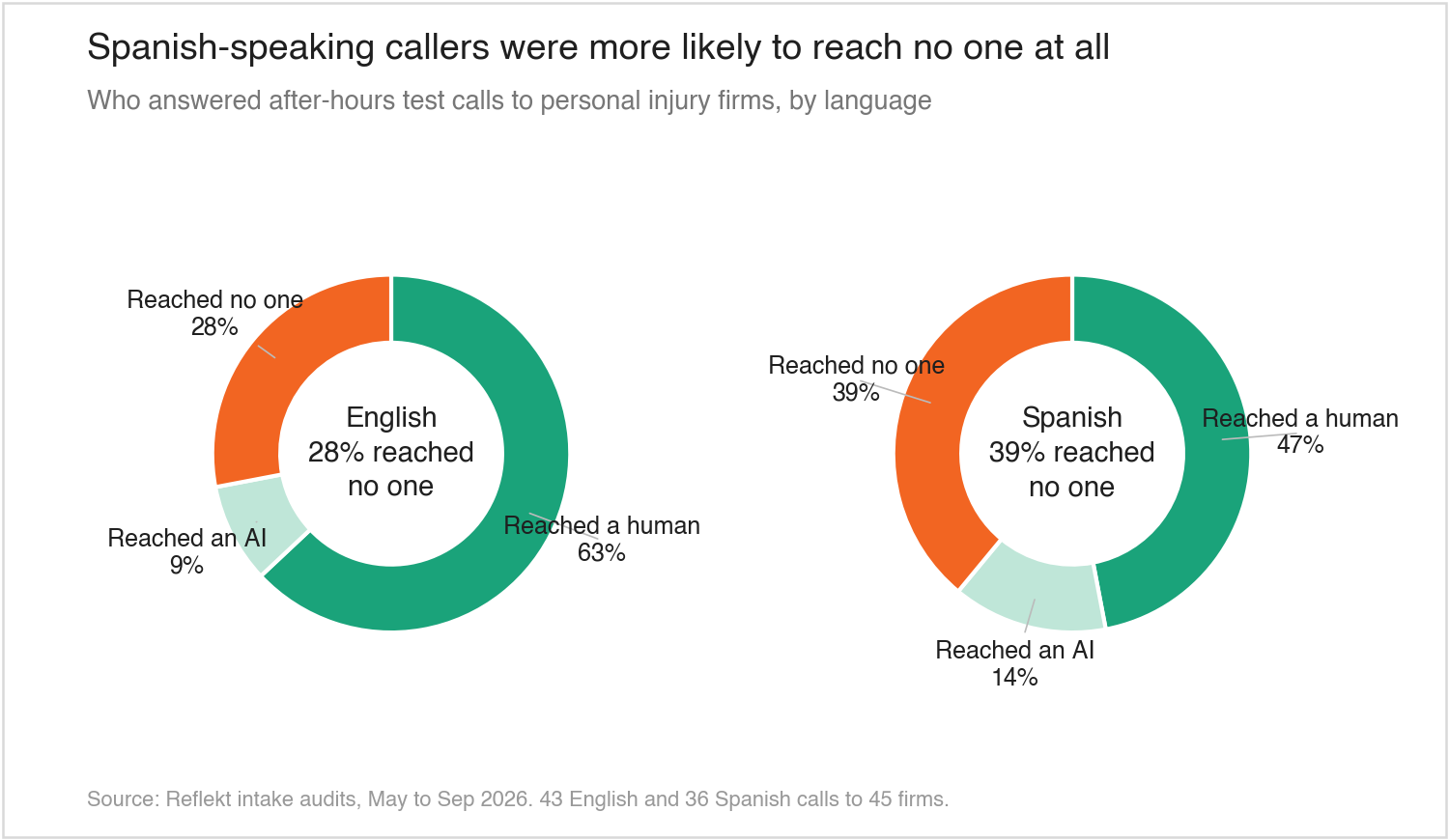
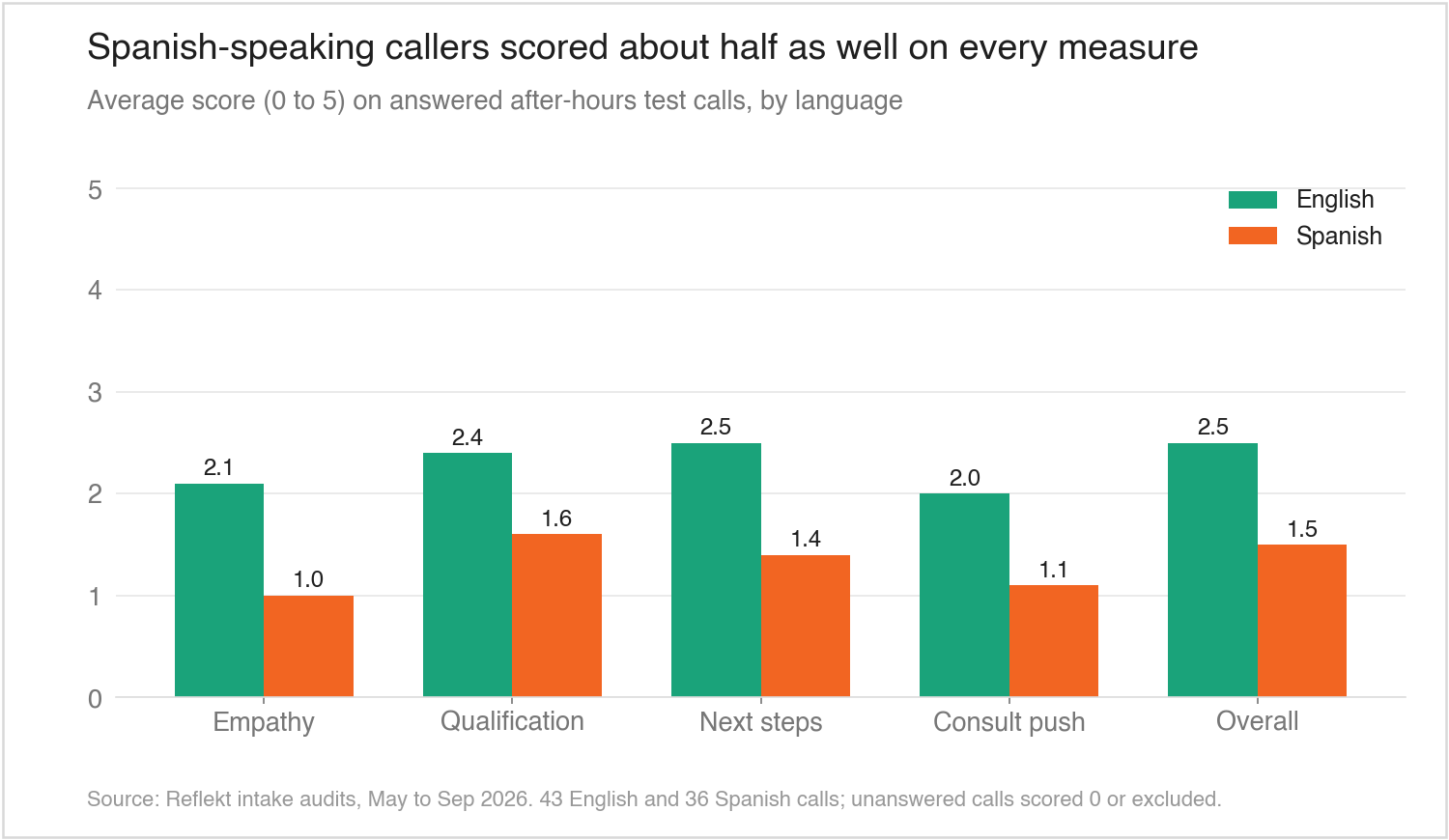
Across all 79 tests, Spanish was offered, as a menu option or an available speaker, in only 21 (27%). The most common Spanish failure was a polite dead end: the person who answered did not speak Spanish, could not find anyone who did, and told the caller to call back tomorrow. For a car-accident victim that is a lost lead. For someone whose husband was picked up by ICE that afternoon, it is a lost night.
Case-status calls are a volume problem, not a sales problem
For most practice areas, the phone is mainly about new business. Immigration is different. Cases run for months or years, USCIS timelines are opaque, and clients call every few weeks to ask whether anything has happened. Each call is short, repetitive, important to the person making it, and pulls a paralegal off the work that moves cases forward.
An AI receptionist that is integrated with the firm's case management system can take most of that volume. When a known client calls, Reflekt reads the matter data, confirms who is on the line using whatever verification the firm requires, and relays the status fields the firm has chosen to expose. "Your I-130 was received on the date we have on file and we have not received a decision yet" is a complete answer for most of these calls, and it is one the client can get at 9 p.m. in their own language. If the client wants to speak with their paralegal, the receptionist logs the request as a task on the matter and the paralegal calls back with the file already open.
What the receptionist does not do is interpret. It will not tell a client whether a receipt notice means approval is close, whether to travel, or what to do about a Request for Evidence. Those are legal questions and they go to a human. We wrote about the design of this workflow in AI case updates for law firms.
Reflekt integrates at all three levels, reading matter data, writing an intake record for new leads, and writing notes and tasks on existing matters, with Clio, MyCase, Lawcus, Lawmatics, and Filevine, among others. If your firm runs on something else, we can still build the connection.
Payment plans by phone
Immigration fees are commonly paid in installments, so a steady share of existing-client calls are about money. A client who calls ready to pay wants it to be easy: someone on the line who can take the payment right away, in the client's own language, and confirm it before they hang up. Every "call back during business hours" or "we'll send you a link later" is a chance for the payment to slip, and for a client who is already anxious about their case to feel the firm is hard to deal with.
Taking the payment on the first call removes that friction. The client is done in a few minutes, the payment is recorded on the matter, and nobody at the firm has to chase it. Reflekt can handle payments by phone; plan details are on the pricing page.
After hours and weekends
Across the 50,000+ inbound calls that Reflekt answered for US law firms between April and September 2026, 15.2% came in before 8 a.m., after 6 p.m., or on a weekend, and weekends alone accounted for 5.3%. Those firms include immigration practices.
For an immigration firm, the after-hours call is disproportionately the detention call. ICE enforcement does not keep office hours, and the family finds out in the evening. If that call reaches an English voicemail box, the family starts dialing the next firm. If it reaches a receptionist who answers in Spanish, takes the A-number, and says the attorney will be notified right now, the firm has the case.
What a good multilingual intake sounds like
A bilingual answering service means a Spanish speaker is on shift some of the time. Language matching means the caller never hears the wrong language first. The receptionist answers, hears Portuguese, and continues in Portuguese. It does not ask the caller to press 2 or put them on hold while someone is found.
The intake itself should also be built for the practice area. One failure our testers logged during the audit was an AI receptionist that asked a Spanish-speaking caller whether they were calling from jail. That is what happens when a script written for one practice area is dropped onto another.
On tone: immigration callers are often scared, and some are embarrassed to be calling a lawyer at all. As we wrote in do clients mind talking to an AI at a law firm, callers react to being unanswered or made to repeat themselves far more than to who is answering. A calm receptionist that speaks their language and writes down what they said is, for most callers, a better experience than a rushed human who does not.
Who this is not for
Reflekt does not provide human receptionists as a fallback. If your firm wants a person on standby for every call, in every language, at every hour, you will need a staffed service, and you should expect to pay for the staffing. We say so on our comparison pages.
Reflekt also does not give legal advice, and it is not a substitute for an attorney on a detention call. It gets the facts, flags the urgency, and gets the attorney on the phone as fast as the firm's routing rules allow. If nobody at the firm will take an evening callback, it can still collect the intake and book the earliest slot, but it cannot make a lawyer appear.
Finally, the case-status workflow depends on an integration with your case management system and on the firm deciding which fields may be read back to callers. Firms that keep status in a spreadsheet will get a receptionist that takes good messages but cannot answer "any news?" on its own.
How Reflekt handles immigration intake
Reflekt's AI legal receptionist answers every call 24 hours a day, matches the caller's spoken language automatically across 15 or more languages, and runs an intake built for immigration matters: new-matter consults, detention emergencies, case-status checks, document requests, and payments. It transfers live during the hours the firm defines using call routing and live transfer, and it writes an English summary to the firm's case management system through call summaries and CRM sync.
For a firm whose callers are mostly Spanish-first and whose emergencies arrive at 8 p.m., that combination is the difference between a case and a voicemail.
Frequently asked questions
Does the AI receptionist speak Spanish?
Yes. Reflekt detects the language the caller is speaking and responds in it, with no menu option to press. Spanish is one of 15 or more supported spoken languages. The receptionist runs the full intake in Spanish and delivers the summary to the attorney in English.
How does it handle a caller whose relative is detained?
It treats the call as urgent. The receptionist collects the detained person's name, date of birth, A-number if known, where and when they were taken, and the caller's relationship and phone number. It then transfers live if the firm has someone on call during defined hours, or sends an immediate notification and books the earliest callback. It does not give legal advice about the detention.
Can it answer "is there any update on my case?"
It can when the firm has enabled an integration with a supported case management system such as Clio, Filevine, Litify, or MyCase. The receptionist identifies the caller, verifies them according to the firm's rules, and relays the status fields the firm has permitted it to share. It does not interpret what a status means or give legal advice; questions like that are logged as a task for the attorney or paralegal.
Which languages are supported?
Reflekt supports 15 or more spoken languages, including Spanish, Portuguese, and Mandarin. Detection is automatic, so a caller who begins in one language is answered in that language from the first sentence. If you serve a community whose language you want to confirm, ask during the demo and test it with your own callers.
Does the attorney get the summary in English?
Yes. Regardless of the language spoken on the call, the summary written to the case management system or sent by notification is in English, and it notes the language the caller prefers so the firm can plan the callback.
If you want to hear how it handles a Spanish-first detention call, you can interview your AI employee and test it with your own hardest scenario. Plans start with a free tier for solo attorneys, and the details are on the pricing page.
